Last Week's Meeting
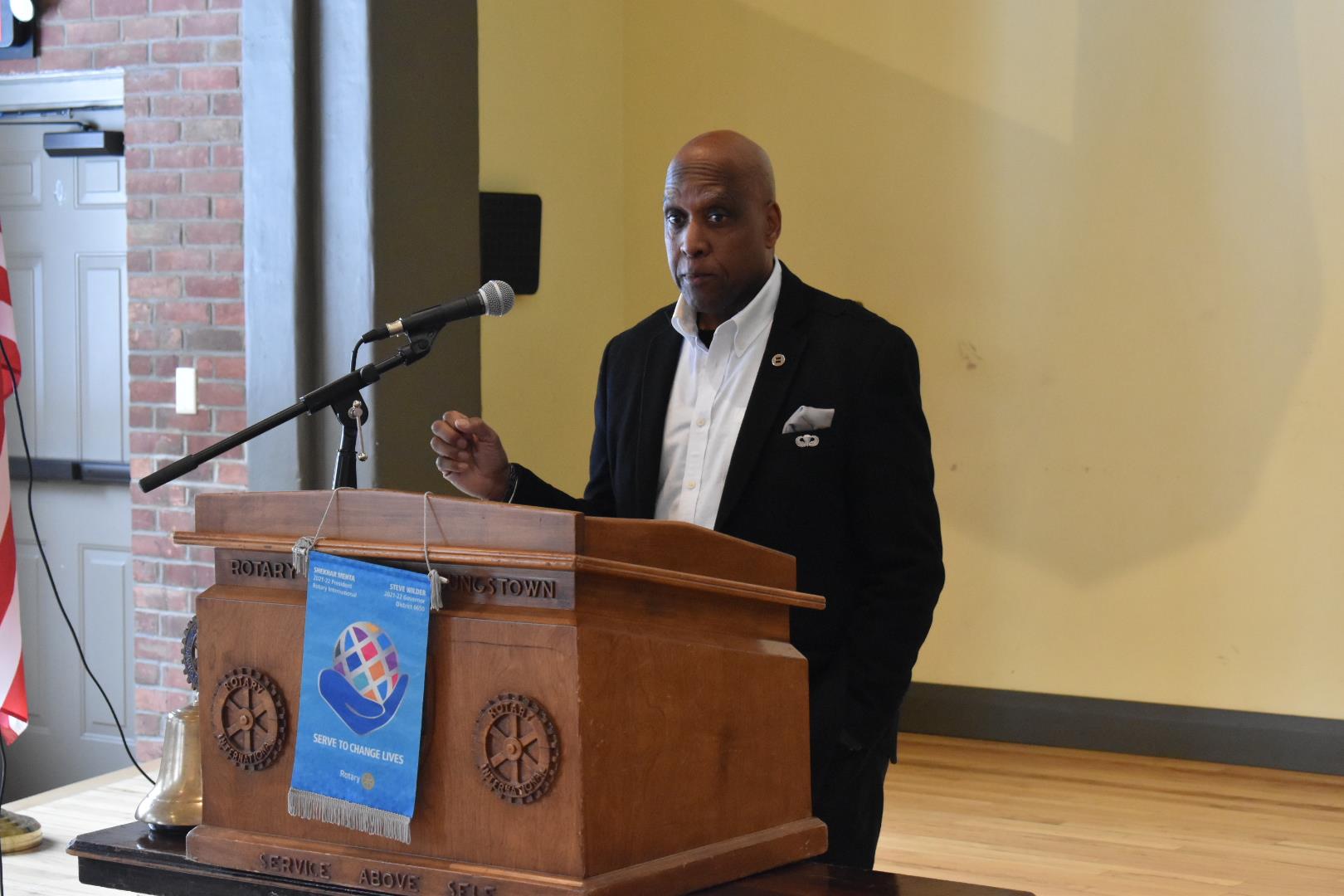
Speaker Mike McNair, publisher and editor of The Buckeye Review newspaper, relates the racial reckoning that followed the death of George Floyd in Minneapolis with something written by the late Dr. Martin Luther King Jr. while he was imprisoned in a Birmingham, AL jail: Negative peace is the absence of tension, and positive peace is the presence of justice.
The Buckeye Review has reported on news in Youngstown and Warren, with emphasis on the African-American community, since 1937. McNair was introduced by RCY member Dionne Dowdy, whose organization United Returning Citizens also operates out of the Oak Hill Collaborative on Oak Hill Avenue.
Rotarians may know McNair from when he was Communications Supervisor for Youngstown City Schools, or as founder of the mentoring program 100 Black Men. He also is an ordained minister, Ohio licensed clinical social worker, and co-owner with his wife, Dr. Linda McNair, of a private clinic counseling service.
McNair citied “Race Talk and the Conspiracy of Silence,” a book by Derald Wing Sue, about why people avoid discussing racial issues. Whether they act out of fear of being impolite, or because the narrative contradicts their own understanding of history and culture, “not talking about race makes it worse,” McNair said. “Ignoring it is like ignoring pain in your chest, or a lump in your breast, or a leak in the basement. … The silence of not talking about race doesn’t help society.”
He also cited another portion of Dr. King’s Birmingham letter, in response to a white man’s advice that he should be more patient in his quest for equal rights: “We will have to repent in this generation not merely for the hateful words and actions of the bad people but for the appalling silence of the good people.”
During February, The Buckeye Review is hosting discussions on the social, physical, mental health, spiritual and political implications of racism. Conversation will be inspired by the book “The Color of Law: A Forgotten History of How Our Government Segregated America.” McNair stressed the importance of learning about racial history, which “may be painful but moves us forward,” he said.
Furthermore, he offered this question as the basis of conversations on race: “How do we love one another even in the midst of pain?”